Monday, 15 May 2017

The Story of Silk: A Study Day at the Silk Museum, Macclesfield.


The fifth Textile Stories Study Day took place on 1st April 2017 at the Silk Museum, Macclesfield. The day focused on exploring the history, manufacture and uses of silk.


The event started off with a lecture by Dr Katherine Wilson, Senior Lecturer in History at the University of Chester and an expert in European luxury fabrics of the late medieval period. In a fascinating talk, titled Europe's Rich Fabric: The Growth of Luxury Textiles, Dr Wilson discussed the development of the silk trade in Italy, the Netherlands and France, and how it contributed to a consumer boom in luxury goods. Focusing on Dijon in France, she explained that an examination of the wills and inventories of shopkeepers and merchants showed that silk goods, and other luxury textiles, were widely owned and bequeathed after death. Her talk was wonderfully illustrated with images of beautifully decorated silken items, from cloaks to altar cloths.


Following Katherine’s talk, participants were able to enjoy a guided tour of the silk museum’s facilities, which included viewing items from the collection which were not normally on display and seeing the looms in action. It was possible to get a sense of how the workers at the silk mill must have felt as they worked the machinery in rather cramped and noisy conditions.


A practical session was offered in the form of a creative workshop, Crafting Silk Stories. This was organised by Emily Wilkinson, an artist and poet who takes her inspiration from the natural world and textiles. Emily encouraged participants to create books based on their personal responses to and ideas about silk. Using text, images and scraps of fabric, people created some fascinating small books to take home and keep.


The final talk of the day, Taming the Wild': Thomas Wardle's transformation of the wild silks of India was given by Dr Brenda King, Chair of the Textile Society. She spoke about Thomas Wardle, a local silk manufacturer whose experiments with natural dyes and Indian tussar silks prompted William Morris to travel to Leek to study with him. Dr King explained how problematic the dyeing of raw silk had been until Wardle found ways to use plants to produce silks in wonderful colours. She also discussed the work of Wardle’s wife, Elizabeth, who taught embroidery and was responsible for many of the exquisite church textiles which were created as part of the Arts and Crafts Movement.


Participants also brought beautiful examples of silk items with them, which were a joy to see, meanwhile the till was busy ringing as people bought books, scarves, ties, handkerchiefs and postcards in the Museum’s gift shop.


Deborah Wynne, Professor of English at the University of Chester and Sue Hughes, Director of the Silk Museum, collaborated on the organisation of this event. They would like to thank Jan Gibson for taking the photographs and Brenda Rewhorn for helping with the workshop.


Our next study day will focus on textiles and working people and will take place in April 2018 in Shrewsbury. More details will follow in the near future.


Monday, 30 January 2017

An Interview with Emily Wilkinson


Deborah Wynne asks Emily about her practice as a poet and artist.
DW:  You use text quite often in your art, do the words inspire the artwork, or does the art inspire the words?
EW: They usually evolve at the same time, I find that making visual work evokes a mood which then informs the language I am attracted to, and vice versa. Having said that, I sometimes write words inspired by a visual piece or a photograph, but don’t often come up with artwork based on pre-existing words.
 
DW: How do you source the materials in your textile art and collages?
EW: I collect magazines, second hand books, postcards and bits of ephemera. It helps to be a bit of a hoarder! I also save scraps of nice paper and offcuts of fabric. Most of the fabrics I use are second hand; either finds from charity shops or old things I cut up. I also create my own surfaces by putting papers and fabrics through processes to make texture and alter colours. Scrapstores are a great resource too, and luckily we have one locally in Church Stretton. 
 
DW: The natural world seems to be a considerable inspiration for your work – why is this the case?
EW: I’m a country girl at heart and feel happiest when surrounded by nature or not far from wild places. By working creatively with or in landscapes I think we explore our inner emotional worlds. I suppose that for some people that might be cities or urban environments, but for me it’s mountains and oceans. I also find our connection as humans to the natural world fascinating, and care about protecting the environment. 
 
DW: What are the challenges of creating 3D artwork?
EW: Some of my 3D work is actually quite flat so in a way it’s not so different to working with collage, just in relief. With items such as my paper shoes it’s more like creating a garment from a pattern, these are quite fiddly to make however! I haven’t worked on a large scale in 3D which is where the real challenge would probably come in. 
 
DW: What are your favourite textile fabrics to work with?
EW: As mentioned earlier I like to work with second hand fabrics to give them a new life, I also like the sense of history and stories they carry. Wool is lovely to work with and I enjoy other natural fibres like linen, bamboo and silk which is one of the reasons I am really looking forward to working with you at Macclesfield Silk Museum next April.
DW: What inspires you to create book arts?
EW: I’ve always loved books and have read a lot since early childhood. I love them as tactile, comforting, intriguing objects and am not draw to kindles or e-books in the slightest! 
 
DW: How did your film poem, Lines of Flight develop?
EW: It came out of a series of conversations with a friend (and other writer of the piece) Jeppe Dyrendom Grauggard who I met through the Dark Mountain Project (http://dark-mountain.net). At the time he was living in Berlin and I in Scotland, and after talking about subjects like home, nomadism and belonging we started an exchange where we filmed clips from the environments we lived in and started writing from them. We were very pleased indeed when it got screened at the Antwerp Filmpoem Festival about three years ago. 
 
Emily Wilkinson will be running a creative workshop at the Story of Silk event at Macclesfield Silk Museum on 1st April 2017. To find out more about this event, see the previous blog post or email: d.wynne@chester.ac.uk


Monday, 5 December 2016

The 2017 Textile Stories Study Day: The Story of Silk

This study day will be held in The Silk Museum, Park Lane, Macclesfield, SK11 6TJ on 1st April 2017, 10.00am-3.30pm


The event will explore the magic of silk, its uses and its histories. This study day will involve talks by a textile artist, Yvette Hawkins; a historian of luxury textiles, Dr Katherine Wilson, who will talk about the colourful history of the luxury textile trade in Europe; and a practical workshop organised by Emily Wilkinson, an artist and writer.


Included in the cost of the event is a guided tour of the Silk Museum, a fascinating place which reveals the importance of silk manufacturing to the history of Macclesfield and shows how silk is made, from cocoon to loom. Additionally, there’ll be some hidden gems from the collection on display. The Museum will be closed to the public on the day of the event.
Here is the Museum’s website link:  http://www.silkmacclesfield.org.uk/


If you would like to join us for this 5th Textile Stories Study Day, please book a place by phoning: 01625 613210 (to make a credit/debit card payment) or by visiting the Museum (where you can pay with cash). Tickets cost £20 and include lunch, refreshments and a tour of the museum.
This event is jointly organised by the University of Chester and the Silk Museum, Macclesfield. We’re looking forward to seeing you in April for what looks to be a really interesting day. If you have any queries, feel free to contact Professor Deborah Wynne at d.wynne@chester.ac.uk or Sue Hughes, Museum Director of Macclesfield Museums, on 01625 613210.

Tuesday, 10 May 2016

The Story of Wool: the fourth Textile Stories Study Day, 23rd April 2016

The fourth annual University of Chester Textiles Stories Study Day took place on the 23rd April 2016 at the Guildhall, University Centre Shrewsbury. ‘The Story of Wool’ was the focus of this year’s event and the diverse schedule of talks, displays, and stalls offered something for everybody, whether a knitting novice or spinning expert!
   Jean Huff, spinning in the foyer               Woollen items made by participants at the event
                The talks got off to a fascinating start thanks to textile artist Fiona Nisbet. Fiona talked us through the steps involved in the creation of her beautiful textiles, which begins with sourcing the ideal sheep. Once she has found the best fleece, Fiona explained how she starts the process of spinning the raw material into thread, using the techniques of carding or combing depending on the design she hopes to produce. She then talked us through the various dyeing and weaving techniques, before explaining how she transforms the end material into her stunning designs. Fiona very kindly brought in some of her pieces, so we were lucky enough to see (and even buy) some of her original work.

 Fiona Nisbet talking about fleeces

                Next up were Dr Graham Atkin and Professor Deborah Wynne, both English lecturers. Their talk: ‘Woolly Stories: From Shakespeare to the Brontës’ focused on the importance of the pastoral, wool, and the wool trade within the literature of Shakespeare and the Brontës. Graham discussed his interest in the pastoral literature of the Renaissance by taking us through images from Edmund Spenser’s The Shepeardes Calendar (1579). We were also given examples from several of Shakespeare’s plays where pastoral imagery can be found including As You Like It (1600) and The Winter’s Tale (1611). Deborah’s talk centred around examples of the wool trade in the work of the Brontës, especially their childhood experiences of the Yorkshire woollen mills. Deborah explained how both Branwell and Charlotte took inspiration from the mills near their home in Haworth, an area where the spinning and selling of wool was an essential part of the local economy. Deborah focused on Branwell Brontë’s The Wool is Rising (1834) and Charlotte Brontë’s Shirley (1849) in her talk.

 Graham Atkin talking about Shakespeare.         Deborah Wynne with some members of the Shropshire Spinners and Weavers Guild
                After a delicious lunch, everybody was ready for the third talk of the day from the local sheep farmer, Thelma Thompson. Despite a successful career as a solicitor, Thelma decided she had had enough of her office in the city. After heading to a sheep market with her friend, farmer Henry, Thelma had a chance encounter with a small but feisty ram named Tinker. Before she knew it, she had purchased Tinker and the rest was history! Thelma’s fascinating talk detailed the highs and lows of being a twenty-first century shepherdess. Though she has had to deal with financial pressures, long hours, and never-ending administrative work, she is also able to spend every day in the great outdoors, breeding and rearing her sheep with Henry’s help. Thelma’s talk included some beautiful photographs of her new lambs, while her stall provided some more opportunities for retail therapy!

Thelma Thompson with some useful leaflets from the Wool Marketing Board
               
                The final talk of the day was given by Professor Sandy Black from the Centre for Sustainable Fashion, at the University of the Arts, London. Sandy has enjoyed a varied and fascinating career as a designer, a researcher and an academic. Her talk, ‘Wool in Knitting and Fashion: From underwear to couture’ focussed on the important role knitting has played in fashion throughout the ages, from beautiful examples of early knitting in the fifth century, to couture pieces from the modern day. Sandy explored in detail how wool has maintained its cultural importance in domestic terms, especially throughout the nineteenth-century, when knitting was used to make extra money, and as an educational tool in schools. She transported us through history, up to the twenty-first century, when wool strengthened its importance as an art form for modern designers whose work graces catwalks, and can be seen amongst the pages of Vogue magazine.
One of our participants holding a 'Sandy Black' jumper she knit in the 1980s. Her friend holds the original pattern,
Minnie and Bryony, University Centre Shrewsbury students who kindly helped out on the day.

The fourth Textiles Stories Study Day provided a wonderful opportunity to hear expert speakers talk about wool and knitting in original and fascinating ways. We do hope you will join us next year for the story of silk at Macclesfield Silk Museum on the 1st April 2017. 

Report by Katie Baker, PhD student, English Department, University of Chester

Saturday, 27 February 2016

Textile Stories Study Day: ‘The Story of Wool’ 23rd April 2016

The fourth Textile Stories Study day will be devoted to the 'story of wool', from fleece to fashion. The event will be held on 23rd April at the new University Centre Shrewsbury and there will be talks, demonstrations and displays. 
The programme for the day:
9.30-10.00am: Registration (tea/ coffee) (demonstrations/ stalls/ displays)
10.00-10.50am: Fiona Nisbet (textile artist), ‘Spinning: from Fleece to Fabric’
10.50-11.30am: Tea/coffee (demonstrations/ stalls/ displays)
11.30-12.20: Deborah Wynne and Graham Atkin (both University of Chester), ‘Woolly Stories: From Shakespeare to the Brontës’
12.20-1.40pm: Lunch (demonstrations/ stalls/ displays)
1.40-2.30pm: Thelma Thompson (sheep farmer), 'It All Began With Tinker... Tales from a Shepherdess under Wenlock Edge'
2.30-3.20pm: Professor Sandy Black (Centre for Sustainable Fashion, University of the Arts), ‘Wool in Knitting and Fashion: From underwear to couture’
3.20pm: Closing remarks
Tickets cost £15 and can be bought via the University of Chester's Shopfront Shopfront.chester.ac.uk/index.php?main_page=index&cPath=6
Alternatively, you can send a cheque for £15 made payable to 'The English Dept, University of Chester' (put your contact details on the back), and send to Prof D. Wynne, The Guildhall, Frankwell Quay, Shrewsbury SY3 8HQ
The event will take place in The Guildhall, Frankwell Quay, Shrewsbury SY3 8HQ
A view of the Guildhall from across the River Severn. In the foreground is the 'Quantum Leap', a memorial to Charles Darwin.


Tuesday, 21 July 2015

Textile Stories: Quilt Stories, The Study Day on 25th April 2015

Our third Textile Stories study day was devoted to the topic of quilts and quilting. Quilts come in many forms and have a long history; the stories they tell can be obvious or hidden. Textile historians have done much to reveal the fascinating stories hidden in quilts. At the University of Chester many of us have been rather preoccupied by the idea of quilting because the Anniversary Quilt, celebrating the University's 175th anniversary, took shape over the course of the previous year. It seemed fitting that we explore the history of quilts and the stories they tell for our 2015 study day.

We listen to some thought-provoking and informative talks from our speakers; some were experts on quilts, their histories or the art of quilting. Other speakers shared knowledge and experience in restoring and preserving quilts and organising a quilt project involving a group of sewing enthusiasts. 

Our first speaker was Christine Garwood and she talked about ‘Painting With Stitches’:

Christine, an artist, teaches textile art.  Her work combines cloth, stitching, colour and texture to evoke the landscapes she loves. Her talk focused on the techniques she used and her own personal journey as an artist inspired by the natural world. She brought examples of her work, from projects she had done as a schoolgirl and work she had done at art school, as well as the 'stitched' paintings she had exhibited as a professional artist. The audience found the diversity of material she used, paint, thread, even plastics, intriguing, and Christine was asked lots of questions about how she used her skills with each project.


Christine has a B.A. (Hons) in Fine Art / Textiles, from the University of London, Goldsmith’s College, School of Art and an Art Teacher’s Certificate from the University of Sussex.


Above are some examples of Christine's work displayed during the day.


Our next talk was given by Jacqui Hyman on ‘Conserving Quilts’

Many of us remembered Jacqui's talk in 2014, when she discussed the exciting discovery of medieval Egyptian clothing hidden away in a Leeds museum, and her research and restoration of these fascinating objects. A textile historian and experienced conservator, Jacqui offered expert advice on caring for quilts. Jacqui emphasised that the quilts made today will be of interest to future generations and that we should think about preserving them, as well as enjoying them now. Her talk ranged from restoring historic textiles in museums to ways of cleaning and storing the quilts handed down within families. 


She set up her stall of textile restoration products, and showed people how to use them. She was busy throughout the day, as members of the audience visited her stall and found out more about protecting their lovingly-made quilts for future generations. Jacqui runs the Textile Restoration Studio: http://www.textilerestoration.co.uk/

Claire Smith (Researcher for the V&A exhibition, Quilts: 1700-2010) gave a talk called, Quilts 1700-2010: Hidden Histories from the V&A’s Quilt Collection’
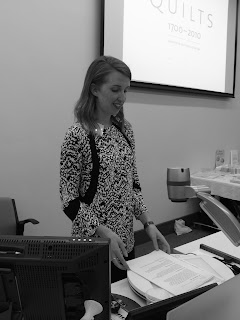
Claire was involved in putting together the major quilt exhibition at the Victoria and Albert Museum in 2010 and her talk was based on the pleasure of researching a number of fascinating quilts from the eighteenth century to today. She talked about what for her were the highlights of the exhibition, and how the research team set about displaying over 300 years of quilt history. Her talk was well illustrated and we saw the rich history of quilts unfolding, from the beautiful work of well-born ladies in the eighteenth century, to the domestic creation of bedspreads in the nineteenth century, to the stitching of individual stories by prisoners in the contemporary 'prison quilt'. Claire emphasised that each quilt had its own story to tell, and that the challenge for textile historians is to uncover and make sense of each story about each quilt's moment in time.

Pat Salt's talk, ‘From Quilt to Quilt’, expressed her sense of how one quilt leads to another and that each marked a stage in her creative journey.


Pat Salt has developed courses on quilting for the City and Guilds qualification and has taught quilting for many years. She brought along many examples of the beautiful, often intriguing, quilts she had made and she invited the audience to examine them closely. We felt privileged at being allowed to handle such beautiful objects. Many people spent quite some time examining the fascinating designs and discussing how they were made. Pat’s talk covered a range of topics, from techniques and sewing strategies to design and the importance of using your imagination. 

Here are some examples of Pat's quilts on display:


Fiona Roberts and Liz Johnson, both from the University of Chester, ‘The Story of the Anniversary Quilt’


Fiona and Liz, on either side of the Anniversary Quilt, gave the final talk. They discussed the pleasures of working with a team of keen quilters, the discussion of ideas, sharing of materials, the problems of design and how they were overcome, and the excitement of seeing the quilt emerge over the course of many months. 

Many people attending the study day brought along some of their own quilts and the hall was packed with a colourful display which made the event a visual feast! Here are a few of them:


Our helpers, Katie Baker, Hannah Brady and Grace Woodger are taking a well-earned break:

Here are some comments from participants:


Inspirational, ideas flowed like running stitches – binding all together. Thank you.
Liz Leech

Such an inspiring day – full of variety.  Talented artists (textile) with so much to offer.  Most enjoyable day – food was great.
Jacqui Hyman


Very successful day!  Every talk interesting and inspiring.  Looking forward to the next one.
Clare Dudman


Excellent day.  Interesting and inspiring speakers.  Wonderful quilts old and new.  A really well organised day and the catering was excellent.  Very enjoyable and educational day.
CG Fairclough

Thank you so much for arranging such an enjoyable day and with marvellous speakers, all on a variety of subjects but all on quilting and stitching.  I have thoroughly enjoyed my day.
Mandy David


A great day – really interesting, inspirational talks, great food, lovely company.  Please add me to your mailing list for future events.  I enjoyed the mix of academic, intellectual material and practical hints and tips.  Symbolism in textiles would be an interesting theme – runaway quits from the underground railway and in weavings as in Lady and the Unicorn by Tracey Chevalier.  So lovely to get up close and personal with real items – particularly in Pat’s talk and from participants.
Debbie Marais


This has been an amazing day which fulfilled all my expectations.  Every speaker brought a new aspect of the world of textiles to our attention.  One could not help but be encouraged by their enthusiasm.  The day was very well organised – timings, catering etc. were excellent.  Thanks to you all for organising such an inspiring day.
Hilary Watmough