Tuesday, 18 March 2014

175th Anniversary Quilt: March 2014 Update

Fiona Roberts reports:

At last, all 25 blocks have been stitched together!  Six members of the group met up at the Quilter’s Trading Post on 1st March, armed with pins, tape measures and sewing machines, ready to put the blocks together.


The Quilter’s Trading Post is an Aladdin’s cave of quilting fabrics, notions and pure inspiration for the creative quilter!  
Inside the Quilter’s Trading Post

Formerly a primary school, it has been successfully converted into retail and workshop space, as well as the machine room, where two long arm quilting machines are permanently busy with a substantial waiting list.  This is where patchwork is quilted using computerised patterns co-ordinated by the experts!

Proprietor of the Quilter’s Trading Post, Emma Ablett, kindly provided a room for us to sew, as well as a very welcome cuppa.  We browsed the extensive shelves of fabrics, looking for a suitable colour for the sashing. (What a treat!)  Once we had made our selection, Felicity sliced this up into the requisite strips and added all the horizontal pieces.  Other members of the group double checked the blocks and added a few stitches here and there to secure them. 

Jenny, Helen, Kath and Felicity hard at work!

The day raced by and we left, with Helen and I each taking half of the quilt home with them, to add the vertical sashing.  This sounds simple, but every block and sashing strip needs to be re-measured to be certain that it is exactly the right size; otherwise the lines won’t be level.  I then put the two pieces together and added the border.  This was a contrasting colour, which I am not divulging, so that you have a surprise when the quilt is unveiled!  I returned to the Quilter’s Trading Post on 8th March and left our pieced quilt top in Pam’s capable hands to be quilted professionally.  I can’t wait for the phone to ring to tell me it is ready to collect!!


Friday, 28 February 2014

The Anniversary Quilt: An Update on Progress

Fiona Roberts Writes:


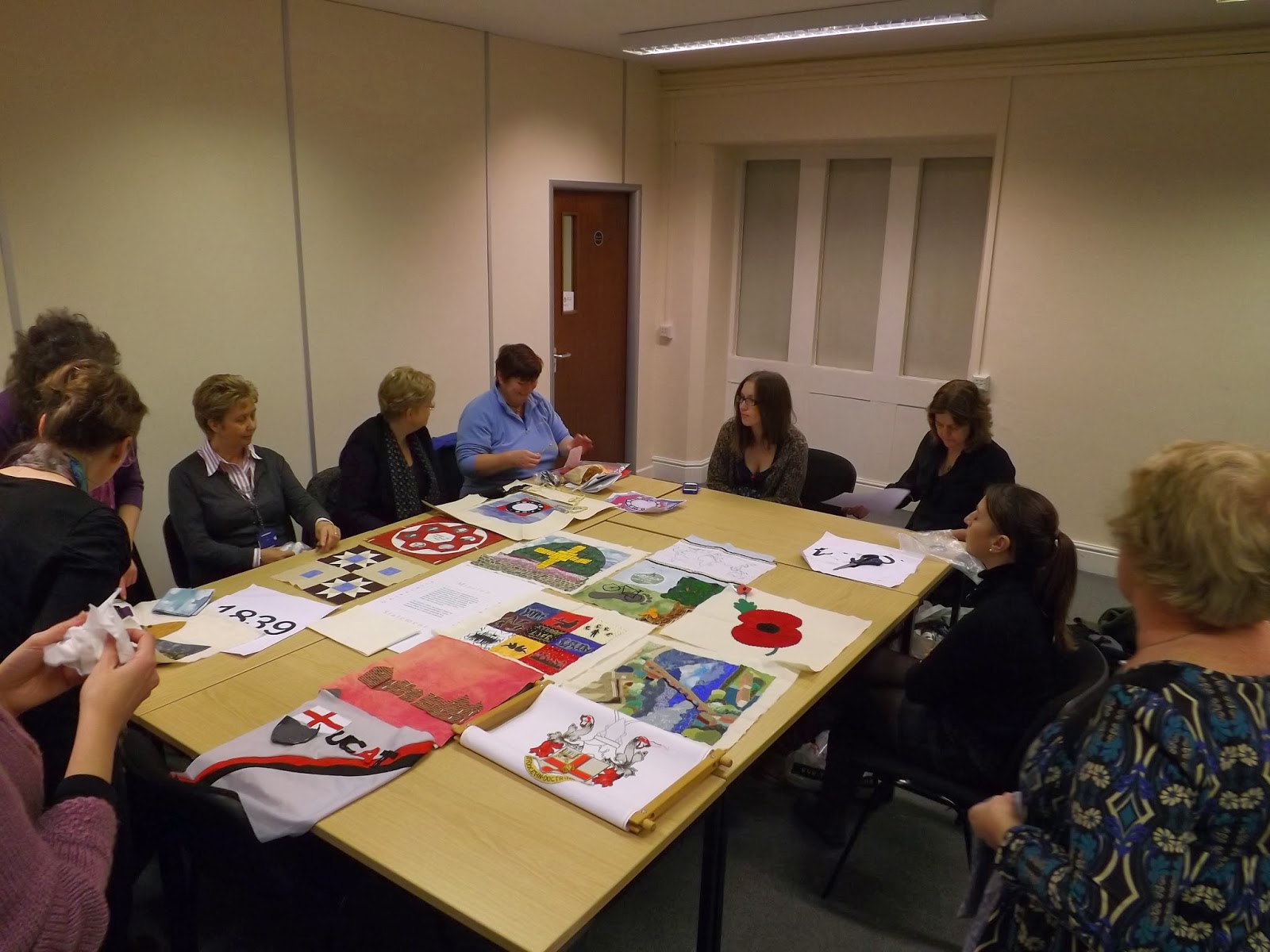
'All 25 blocks have been completed – how exciting!  Every member of staff and alumna has stitched their block with care, and showed such imagination and skill in how they have articulated their themes.  We have such a kaleidoscope of colour, and a fascinating range of interpretations from the group.  At the February meeting, those present laid out all the blocks and decided on what position would be best for he blocks in the final layout.  We photographed this (how could we hope to recall all these without a photo!)


We found that having taken a photo, we decided on a slightly different layout, to make it more balanced with predominant colours not being placed next to each other.


Our Pro-Vice-Chancellor, Adrian Lee was passing and popped in to see what we were up to!'


'A smaller group will be meeting up at the Quilter’s Trading Post in Buerton to stitch the blocks together and add the sashing.  We have decided to see what colour sashing looks best when we are in the shop!

Once the blocks are all stitched together to form one piece of cloth, we will leave this in the capable hands of Pam, who will be putting this on the gammill long arm quilting machine, and quilting the top, wadding and backing fabric together, and enhancing the designs on each individual block.  We can’t wait to see how it looks!

Next on the agenda is compiling the information needed for our book.  Everyone is writing 250 words outlining how they chose the design they created, supplying a photo of themselves and a description of how they are connected to / what they do at the University of Chester. 

Anne, Shirley, Louise, Kath and Pat have a look at Shirley’s draft pages for the book.


Thursday, 13 February 2014

Wearing Rags in Victorian Britain

The circulation of clothing across class barriers created uncanny effects for social observers in the Victorian period. At the Derby races at Epsom in 1861 the French writer Hippolyte Taine noted the confused jumble of garments worn by ‘low’ characters in the crowd, discerning there the ghostly traces of fashionable West End clothes. The vision of unwashed and unkempt people wearing ‘gentlemen’s cast-off clothing’ and the once ‘stylish dresses’ of ladies prompted Taine to reflect:

This tatterdemalion attire, which has clad four or five bodies in succession, I always find painful to see. It is degrading: by wearing it a person admits or declares himself to be one of the off-scourings of society. In France a peasant, artisan or labourer is a man who is different, but not inferior. His working blouse or overall is his own; it has been worn by nobody but himself. This readiness to wear rags is more than a mere singularity; it denotes a want of proper pride; the poor, in this country, resign themselves to being other people’s door-mats. (Notes on England, 1861)

W. P. Frith, Derby Day (1858)

Taine’s belief that hand-me-downs were inadequate clothing because they did not properly fit the wearer, having been made for someone else, suggests that he sees clothing in a modern sense as an expression of identity. He also believes that the poor in France did not wear second-hand clothes but made their own homespun garments. I wonder if this was true?

The multitude of poor people in cities like London and Manchester were forced to wear the clothes rejected by the wealthy, clothes which had filtered down from owner to owner, via pawnbrokers' stores and secondhand clothes shops. The fact that earlier owners' lives could be read in the dilapidated garments worn by the poor suggested to writers like Taine that they had descended to being ‘ragged’, losing their social identities. Yet this sublimation of an individual’s identity into a collective state of raggedness meant that poverty was difficult to ignore. It was always visible on the city streets, particularly in London where beggars shared the West End pavements with wealthy shoppers; the well-off had an ever-present warning of what happened to a person when poverty struck. People in rags also indicated the presence of an underclass, discontented people who had the potential to rebel. Rags thus had a potential to act as political statements, to ‘speak’ of social inequality, to express discontent on behalf of the wearer who had no effective public voice. Visible raggedness inevitably made a statement.


Image: Children Rescued by Dr Barnardo
http://www.goldonian.org/barnardo/1866_barnardo's_year.htm


Tuesday, 4 February 2014

The Anniversary Quilt: An Update


Kath Roberts reports that her cross-stitch block representing the University of Chester crest is now finished. She adds, ‘I have decided to outline some of the main shapes to give definition.’


The mission statement square is also just about completed, with just some outlining in backstitch to do.


Kath writes: ‘The next square I have taken on is one to represent the celebrations for the inauguration of the University in September 2005.  As part of the Balls held for the celebrations fireworks displays were held and I have decided to represent these on black velvet, using fabric paint and metallic threads, with beads and sequins to be added on following the completion of the quilt by the Quilters Trading Post.’ 


'I have approximately 4 weeks to do this square before our Saturday session at the Quilters Trading Post on the 1st of March. Then we will choose the sashing, before cutting and sewing the squares and sashing together, this has by necessity to be a quick square to complete!  So I am intending to use mainly fabric paint and pens in silver and gold to produce the bulk of this work.  The stitching in metallic threads will be mostly stem stitch, chain stitch and bullion knots.'

Amy Jones has now completed her block, the Amber ‘Peace’ cross designed by Frederick Starkey in the garden outside the Cloisters:


We are all awaiting the moment when the quilt will be assembled after the 1st March meeting.

Monday, 13 January 2014

Dickens in the Burial Place of the Fashions


Second-hand clothes shops are as much a feature of our era as of the Victorian age. Now, primarily labelled as charity shops, they regularly pop into existence to fill the retail voids in all our towns and cities, many of them settling into those voids as comfortably and tenaciously as any hermit crab. In Charles Dickens’s time of course ‘charity’ was funded by direct philanthropic donations, or by the circuitously indirect route whereby worthy ladies sewed or tatted items of dubious utility which they then sold to each other in order to raise funds for their less fortunate neighbours.

In contrast, Victorian second-hand clothes shops had nothing to do with any charity other than that which began at home. Their owners survived by selling such items as ‘a deceased coat … a dead pair of trousers … the mortal remains of a gaudy waistcoat’ to the poor who gave the clothing a second lease of life. In his early collection of essays, Sketches by Boz (1836) Dickens uses graveyard imagery in ‘Mediations in Monmouth Street’, not only to indicate the usual source of such clothing but to highlight the fact that Monmouth Street had for generations been the home of second-hand clothes dealers who, having eventually grown singularly unimpressed by changing tastes, preferred to ‘immure themselves’ in ‘the burial place of the fashions’; a place for which Dickens declared a ‘particular attachment’.


It was the ideal place for his hyperbolic imagination to take flight: ‘We love to walk among these extensive groves of the illustrious dead, and to indulge in the speculations to which they give rise … and endeavouring, from the shape and fashion of the garment itself, to bring its former owner before our mind’s eye’. Such speculation leads him to see, in a collection of suits displayed outside a shop window, one individual’s ‘whole life written as legibly on those clothes as if we had his autobiography engrossed on parchment before us’. The chapters of this autobiography are composed around the following outfits:  
 
 
  • Firstly, the ‘much soiled skeleton suit’ of a small boy, with knees rubbed white through playing on the floor, and the sticky smears of sweets around the pockets and under the chin providing evidence of the kindly nature of the child’s ‘indulgent mother’. Then the schoolboy’s ‘corduroys with the round jacket’ splashed with ink as he learnt to write.
 
  • The ‘diminutive coat’ he wore as an office ‘message-lad’ is mentioned next; this position had been secured for him by his selfless widowed mother who, in Dickens’s imagination, cheerfully sacrificed her own food to nourish her growing boy. But Dickens implies that base nature cannot be improved by loving nurture.
 
  • The next outfit allocated to his subject is a ‘smart but slovenly’ suit, ‘redolent of the idle lounger’ and his ‘blackguard companions’. The companion image of the anxious mother is evoked, feverishly waiting for the wastrel in her ‘solitary and wretched apartment’, then stoically bearing the ‘brutish threat’ or ‘drunken blow’ on his return.
 
  • Next, a ‘broad-skirted green coat with large metal buttons’ conjures the form of a repulsive ruffian with ‘a dog at his heels’ (the ghostly herald of Bill Sykes perhaps) whose wife and child starve while he staggers, once again, to the tap-room. For Dickens the ‘vices of the boy had grown with the man’, or with the clothes.  Pathos (or bathos) cloaks the narrative as the mother dies, abandoned in the workhouse, still ‘imploring pardon for her son’.
 
  • A ‘coarse round frock, with a worn cotton neckerchief’ completes the history, as the sins of its wearer carry him inexorably to transportation, or to the gallows.
 

 Dickens restores what he claims is his ‘naturally cheerful’ disposition by fitting imaginary feet into a ‘corps de ballet’ of boots and shoes, and setting them off on a riotous dance which closes the piece, and which  I strongly recommend as an antidote to the dire tale of the suits.

However, I blame Dickens for the fact that I now have to fight the temptation to ‘see’ the past wearers of clothes displayed in the windows of second-hand clothes shops – even if few of those outfits will have clothed such a grim or grisly individual as the one whose ‘ghastly form … lay rotting in the pauper’s grave’ while his garments haunted ‘the burial place of the fashions’!           

 
Sue Elsey, University of Chester. 

Thursday, 12 December 2013


An Update on the Anniversary Quilt
December 2013


The quilt group decided to have a get-together at the end of term to place all finished (and nearly finished) blocks together on the table, to see how they looked. This would help to show which colours were predominant and to identify aspects of the University's 175 year history not yet represented. The table was a kaleidoscope of colour, texture, fabrics and stitches: it was fun to take a step back and review our achievement!


Of the 25 blocks, 21 have been started, and 6 completed already. Fifteen members of the group attended, admiring each other’s handiwork. Several felt that they would have time during the Christmas holiday to complete their blocks in time for the next meeting, as the weeks leading up to Christmas are so busy. Pat suggested that one of the spare blocks could depict Chester College. Fiona offered to look through old photographs and documents to see if there is anything which could be adapted.

Everyone is looking forward to seeing even more completed blocks at the next meeting in the New Year.


Michelle Spruce has given us an update on her block:

My block will represent Student Life. I have worked for the University for a number of years and have also recently become a student again, starting a postgraduate Masters degree at Chester, so I felt this was quite a fitting theme for my block. I also work in the Academic Quality and Enhancement department where we are focused on maintaining and improving the quality of both academic matters as well as the student experience. Due to the pressures of work and study this year I did leave it a little late starting my block and so (in true student fashion) had a mad dash to meet the deadline for having my block finished!!!


The different colours and patterns of the squares I have used in the background represent the variety of students at the University as well as the increasing internationalisation of the student body, with more collaborative partner organisations abroad. The silhouettes represent some features of ‘student life’. Starting at the top left block these are ‘Friendship’, ‘Studying’, ‘Student finance’, ‘Sport’, ‘Reaching for the stars’, ‘Partying’, ‘Standing up for what you believe in’, ‘Reading your subject’, and ‘Graduating’.

I had originally intended to stitch the silhouettes, however due to time pressures I opted for using transfer paper and fabric paint. I think the effect still works ok though. I’m still trying to decide if I need to add any further embellishments including a possible border. It depends how my design looks when put against the others.

Monday, 25 November 2013

The University Anniversary Quilt


During November 2013 the quilters have been making considerable progress and a December meeting has been scheduled where everyone will bring their finished blocks to be laid out.

As Fiona states, we will then be able to ‘see what the predominant colours are and how we can balance these. This will help us decide what the last few blocks need to be, and will show us which colours will be most suitable for our sashing and borders’.

This is how the central blocks of the quilt will look:


Anne's alumni garden square


Kate's UCAT square


Kath Roberts: The University Crest


I’ve been using more than a little artistic licence during the stitching of the crest. For example, I thought the lettering for the motto would look better with a combination of backstitch and stem stitch, as it wouldn’t have been readable in full cross stitches as shown on the chart. I have also outlined the main shapes of the crest in full cross stitches in one colour to emphasize them, and then have filled these in with the charted colours, but have deviated from the computerised chart – if I’ve missed or added stitches in a particular colour I’ve just let it be – the overall finished effect should be the same, and I know I haven’t got the time to keep unpicking and redoing stitches. It is taking me much longer to stitch than I originally anticipated, one of the main reasons I’m not religiously following the chart, the other purpose being that at least the design will have had some creative input from me, instead of just following the computer generated chart.


The University Crest is almost complete!


The Mission Statement square


This has been designed by Louise Botten, former PA to the Vice-Chancellor, however due to other commitments Louise can’t do the actual stitching, so I have offered to do it. It shouldn’t take too long to complete (hopefully) once I’ve done the Crest, consisting of whole cross-stitches and backstitch for the main block of lettering. It will be stitched in the University colours on cream 14 count aida.


Fiona's Beswick building square


Pat's rememberance square


Layout of ideas for the label text


Ideas for the dates


The quilters are looking forward to seeing what has been completed so far laid out at the next meeting. Everyone has been keeping note of the hours they have spent working on the quilt and it will be interesting to find out just how much labour has gone into it so far!