Monday, 2 March 2015

Reading Testament of Youth


The Drama of Costume Reading Group
Saturday 21st February 2015


The fourth meeting of the ‘Drama of Costume’ Reading Group met to discuss Vera Brittain’s memoir, Testament of Youth (1933). The choice of text was timely; not only were people’s thoughts turned to the commemoration of those who fought during World War One, but also the new film adaptation of the book, directed by James Kent and released in January 2015, was currently bringing Vera Brittain to the attention of a younger generation. Many participants also remembered the 1979 BBC TV series starring Cheryl Campbell in the role of Vera, and there were opportunities to compare both adaptations as we discussed this powerful and moving memoir. At our reading group meetings we choose novels and other texts which have been adapted for the cinema and/or television, and we consider the role of costume on screen, as well as how the writers have depicted cloth and clothing.


Vera Brittain in her V.A.D. uniform during WWI


We were fortunate to be joined by Dr Phylomena Badsey, an expert on Vera Brittain from the History Department at the University of Wolverhampton. She opened the discussion with an interesting account of the author’s life and work and invited us to browse through the box of books she had kindly brought along, including a selection of Brittain’s novels and political writing and a first edition signed by Brittain herself. It was helpful to hear more about Vera Brittain’s politics, particularly her feminism, and many participants had found it refreshing to read about the War from a woman’s perspective. Brittain served as a V.A.D., both at home and overseas, and wrote very movingly about the waste of young lives she witnessed.


UNIFORMS

We spent some time discussing the topic of uniforms and how central this was to our visualisations of World War One. Participants wrote down their comments immediately after the discussion. Val Price stated: ‘Until I read the book, WWI was signified by the uniforms of the soldiers. I had not considered the nurses. Uniforms de-personalise those wearing them, they become simply units to be moved around the map’. Yet Val, who currently works in the NHS, emphasised the importance of uniforms in a professional context.

Roland Leighton, Vera Brittain’s fiancé, killed at the front in 1915


The importance of uniforms for medical professionals was seconded by Chris Davies; he agreed that uniforms were ‘vital to symbolise roles and therefore expectations of behaviour’. A retired surgeon, Chris’s interest in Testament of Youth had been prompted by its detailed depiction of medical aid at the clearing stations at the Front. Karen Bond, who also worked in the NHS, focused on the uniform as a marker of professional identity: ‘the wearing of a uniform made an individual a “soldier” or a “nurse”’.


Roland Leighton’s grave (photograph taken by Jackie Davies)


Vera Brittain and fellow V.A.D.s in Malta

Some participants noted that not wearing a uniform could be problematic in war time and we discussed Brittain’s description of her uncle, engaged in vital work in London, unable to join up as a soldier, who was constantly made to feel ashamed of his ‘civvies’. Carol Coles noted that ‘those who “laboured” on the Home Front’ were separated from the soldiers and nurses, and Jackie Davies agreed, stating that ‘it was difficult for those engaged in vital war work who had no uniform’. She added that when she worked as a nurse in the 1960s, the uniform she wore resembled that worn by Brittain, which suggests that uniforms exist within a tradition, a form of clothing which changes much more slowly than fashion does.


Cheryl Campbell in the role of Vera in the 1979 BBC series, Testament of Youth. This uniform resembled the one worn by Jackie in the 1960s.

DRESS
We all agreed that it was significant that Vera Brittain often referred in Testament of Youth to the clothes that she was wearing at significant moments of her life, such as her description of the blue crêpe-de-Chine blouse she decides to wear to meet Roland, but at this point she receives the telephone call informing her that her fiancé has been killed in action. Many participants felt that this description of the blouse was not a trivial detail, but a realistic touch. Jackie Davies commented: ‘Any young woman would prepare her outfit ready to meet her fiancé. The moment is rendered more poignant by the description of her carefully chosen blouse’. Susan Preston-Hough agreed: ‘She wanted to record everything about the moment’. Sharon Forsdyke also felt that the colour blue was significant: ‘for me a symbol of clarity and hope’.


Blue is the chosen colour for Vera’s clothes in the 2015 film adaptation.
Here Alicia Vikander plays the role of Vera.


THE UNIFORM AS RELIC


One of the passages we discussed in detail is the account of Vera’s visit to Roland’s mother after her son’s death. She has just received her dead son’s uniform:

Roland’s ‘mother and sister [were] standing in helpless distress in the midst of his returned kit, which was lying, just opened, all over the floor. The garments sent back included the outfit he had been wearing when he was hit. I wondered […] why it was thought necessary to return such relics – the tunic torn back and front by the bullet, a khaki vest dark and stiff with blood, and a pair of blood-stained breeches…’

Both Sharon Kelly and Sharon Forsdyke found this passage ‘harrowing’. Carol Coles agreed, stating that this passage ‘is a very powerful moment as it brings home the nature of the injury suffered by Roland. In addition it highlights the fact that the effects were all that was returned to the family as there was no repatriation of the dead bodies’. Val Price felt that the blood-stained uniform brought the war ‘into the relative safety of family and home’, while Chris Davies found it a ‘brilliant description of an awful moment which must have been repeated in many homes’.


Susan Preston-Hough agreed that the description was ‘moving and very sad’ but added that it was ‘perhaps necessary at this time in order that closure could be granted to the deceased’. A similar point was made by Rosamond Peet, who felt ‘at first sight it seems an inhuman thing to do – how can a parent deal with seeing the clothes a child died in? Yet there are those who need to see these things as part of the grieving process. The sparseness of the writing makes the scene more powerful and shocking’. Karen Bond found it ‘poignant, heart-rending and the simplicity and terseness of the language is compelling’. Sharon Forsdyke added: ‘The emphasis on Vera's crepe-de-chine dress, when she's informed of Roland's death, makes the arrival of his blood-stained uniform even more shocking.’


Jackie Davies planting a cross on Roland Leighton’s grave.

Dr Badsey contributed lots of useful information to our discussion; she explained that Vera Brittain ‘trained long and hard’ and wore her nurse’s uniform ‘with great pride’. She also pointed out that it was ‘normal practice to return the belongings of the dead’ to their relatives, and that for Roland’s family it ‘provided evidence that Roland was never coming back’. She also mentioned that officers owned their own uniforms, unlike those in the ranks.


A scene from the 2015 film adaptation of Testament of Youth.

Sharon Kelly pointed out that those in ‘the ranks were allotted uniforms which approximated to their size and shape’, and this must have intensified the visual separation between the officers (in their tailored clothes) and the men. Dr Badsey explained that there were visual differences between different types of nurses, the various distinctions being signalled in their uniforms. She pointed out the ways in which hierarchies and distinctions were signalled through dress.


Hayley Atwell as Hope in Testament of Youth (2015)

Sharon Forsdyke reflected on the clean, starched nurses’ uniform: ‘Aside from the prevention of disease, a clean starched uniform symbolises one-to-one care. If a wounded solider were faced with a dishevelled, blood-stained nurse, I imagine he might think her incapable of caring for him if she had not taken care of herself; he might feel that his fate may be the same as the previous unfortunate; and there is something reassuring about knowing that a nurse in a clean uniform is there just for you, that one wounded soul, that her attention and yours is not distracted by the thought or evidence of another's state of health or demise.’


The V.A.D. nurse’s uniform, front and back view

We closed the afternoon with a clip from the 1970s BBC series of Testament of Youth, as many participants remembered watching it first time round. We watched the scene where Vera starts work at the clearing station in France and, to her dismay, finds she is tending wounded German soldiers. For those who had never seen this early adaptation, the recently-released DVD was now added to their shopping lists.


A scene from the BBC TV version of Testament of Youth.

Several participants had seen the new film version in cinemas. Rosamond Peet had and she felt that the ‘costumes were very pretty in the civilian scenes, perhaps to contrast with the squalor of uniforms at war’. Sharing our ideas helped us to understand the book better, and we will watch the adaptations with a new understanding of Brittain’s achievement in Testament of Youth. As Sharon Forsdyke summed up: ‘I thoroughly enjoyed reading the book. I understand how Vera may come across as an 'entitled' self righteous member of her class, but putting that into the context of her upbringing, I found her perspective, honest, refreshing and self-deprecating and would certainly have her as a guest at one of my “ideal dinner parties”. Her driving determination to surmount all the odds whilst still being able to embrace the changes, and fight for what is right and just, with a little kicking and thrashing along the way, makes Vera Brittain a model for determined women everywhere.’


Dr Phylomena Badsley added further information about Brittain's work as a nurse and the uniform she wore:


Uniforms of Meaning

Testament of Youth (1933) is filled with references to clothes from school and Oxford University, which demonstrate the interest that Vera Brittain always had in her appearance and throughout the narrative reflect not only events but her emotional state. She took great pride in her Voluntary Aid Detachment uniform, but she earned the right to wear it by sheer hard work and dedication to duty from the start of her nursing career. A rare, relaxed photograph of her and her brother Edward shows them sitting together in uniform on a park bench.


Vera and Edward Brittain, Buxton 1915

Nurses both VADs (with handkerchief style caps tied at the nape of the neck with mid-blue dress, white apron with Red Cross) and the professional trained nurses, in particular the Queen Alexandra Queen Alexandra’s Imperial Military Nursing Service (QAIMNS) (with nursing veil, gray dresses, red capes) were instructed not to smile in photographs and to maintain professional standards of deportment. All photographs of nurses that we have of the First World War are staged; it was not considered appropriate then or now to show them nursing patients. That is why the written accounts of the actual work they did are so important to our knowledge and understanding of their experience of the First World War.


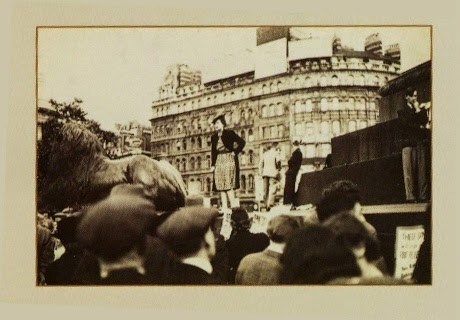
The image of Vera Brittain which most exists in the public consciousness is of a young woman dressed as a VAD nurse, mourning the deaths of her loved ones, helpless and alone, awaiting an uncertain future. A photograph taken in Trafalgar Square in July 1942 at a Food Relief Rally shows the mature women campaigning for victims of conflict, another in 1961 shows her protesting against the Sharpville Massacre. The older images of Vera Brittain deserve to be more widely known both for her political activism and the courage reflected in her eyes as she looks out at the world around her.

Vera Brittain in the 1960s

Dr. Phylomena Badsey MA was awarded her PhD from Kingston University in 2005, "The Political Thought of Vera Brittain", she has published on Vera Brittain as a war reporter in War, Journalism and History - War Correspondents in Two World Wars (2012). She lectures on nursing during the First Word War and is a Visiting Lecturer and Project Manager at the University of Wolverhampton.


Sunday, 12 October 2014

The University of Chester’s 175th Anniversary Quilt Unveiled!

The Quilt Unveiling


On 12 September 2014 the unveiling of the quilt took place at the University of Chester to inaugurate the celebration of its 175-year history. The quilters were at last able to see the culmination of a year’s work. The months of planning, designing, discussing, stitching, and putting together the finished work have resulted in a beautiful community quilt.

Here is the finished quilt:

It consists of a colourful and diverse group of images and stories, each relating to aspects of life at the University of Chester, today and over the course of its history.


The quilt was unveiled by Councillor Bob Rudd, Mayor of Chester and Mrs Susan Sellers, the High Sheriff of Cheshire, with the Bishop of Chester, the Rt Revd Dr Peter Forster announcing the inauguration of the University's 175th Anniversary celebrations.

Photo by Mark English, University of Chester

And here are the quilters, pleased that their hard work and creative energies have resulted in a fine and enduring symbol of the University of Chester. Everyone hopes that it will be enjoyed by students, staff and the people of Cheshire for many years to come.

Of course, an event like this one could not pass without tea and cake! The University of Chester's Catering department created a beautiful cake in the shape of a sewing box, complete with edible cotton reels, scissors and buttons!


Fiona Roberts and some of her fellow quilters will be talking about the making of the quilt at the next Textile Stories Study Day on 25th April 2015. (See the blog posts below for details of this event, dedicated to quilts and their stories.)

Sunday, 13 July 2014

Reading Jane Eyre

The Jane Eyre Reading Day, 5th July 2014

The third ‘Drama of Costume’ reading group discussion was held on 5th July. We talked about Charlotte Brontë’s novel, Jane Eyre (1847), and most participants welcomed the opportunity to read the novel (or reread it) and watch some of the many screen adaptations.  

We focused on the ways in which Charlotte Brontë depicts Jane’s clothing when she is a pupil at Lowood School, ‘uniformly dressed in brown stuff frocks of quaint fashion’ (Chapter 5), and Jane’s wedding clothes when she looks at herself in the mirror and sees ‘a robed and veiled figure, so unlike my usual self that it seemed the image of a stranger’ (Chapter 26). Of course, we also mentioned Bertha, Mr Rochester’s ‘mad’ wife, who tears Jane’s expensive veil, leaving Jane to wear ‘a plain square of blond’ (Chapter 26).


We considered three well-known screen adaptations of Jane Eyre. Firstly, the 1943 film, Jane Eyre directed by Robert Stevenson, starring Orson Welles and Joan Fontaine.
We agreed that the costuming of this film reflected the 1940s much more than the nineteenth-century context of the novel. 

Quite a few participants appreciated the 2006 BBC series directed by Susannah White, particularly the way in which the costume designers dressed Jane in the unglamorous clothing of a governess:

The third adaptation we considered was the 2011 film directed by Cary Fukunaga:


While some participants did not enjoy this film as much as many other adaptations, most people felt that the costumes were very effective.

The camera often focused on close-ups of Jane’s clothes. Particularly memorable is the moment when Jane attempts to take off her wedding gown and we see her fumbling with the complicated lacing at the back of the dress.


The costume designer, Michael O’Connor, has helped to convey the distress of Jane’s position and her feeling that in her wedding dress she is ‘so unlike my usual self that it seemed the image of a stranger’ (Chapter 26). Without a lady’s maid to help her undress, Jane’s solitary condition is emphasised here very dramatically.

I asked participants what they would say to an 18-year-old student who asked ‘Why should I bother to read Jane Eyre?’ and there were many interesting comments offered such as:
  • ·       The novel has a powerful feminist message, for Jane is independent and determined to remain so, even after marriage;
  • ·       Jane Eyre has hauntingly gothic elements, from eerie landscapes to strange mad laughter in an apparently ‘haunted’ old mansion;
  • ·       The novel is a classic love story, where the hero and heroine are not presented as glamorous and beautiful, but as plain (even ‘odd’); yet they are presented as intellectual equals and well-matched;
  • ·       Jane Eyre depicts Jane’s childhood in a memorable way, for Jane suffers abuse and humiliation, yet manages to overcome this. She undergoes an interesting moral development during her years at school;
  • ·       Jane Eyre can be read over and over again, and readers can find something new in the novel every time.


We ended with a quiz and the prize was won by Lynne Hampson.

The next Reading Group meeting will be held on 21st February 2015 and our set text is Vera Brittain’s Testament of Youth.

Monday, 14 April 2014

The Textile Stories Study Day, 5th April 2014: The Drama of Costume

The second textiles study day took place on Saturday 5th April at the University of Chester. Shortly after the event was advertised it was fully booked, and a lively audience attended, consisting of sewing enthusiasts (both professional and amateur), people working in the cultural industries, and those interested in textiles, costume, and costume dramas more generally. Dr Amber Regis from the University of Sheffield also kindly contributed to the day.


This event was generously supported by funding from the Arts and Humanities Research Council through Professor Deborah Wynne's Fellowship [Grant no: AH/K00803X/1].  

The following reports on the event were kindly written by Lucy Johnson and Katie Baker, both of whom are graduate students in the English Department, University of Chester.

Lucy's report on the morning's activities:


The uninvited drizzle did nothing to dampen the enthusiasm for the University of Chester’s Textiles Stories Study Day: the Drama of Costume. Dr Sallie McNamara from Southampton Solent University kicked off the event in style with her presentation ‘”We’re All in it Together”: Downton Abbey, Benevolence and Austerity Chic’. Looking at the first three series of the ITV costume drama, she examined the fascinating concept of ‘costume narrative’ and how clothing is used to represent different aspects of the programme both in and outside the series.


Sallie argued that costume specifically within the series is used in order to reinforce today's ideology of austerity, the idea that ‘we’re all in this together’, and anyone who dissents against the status quo is ‘reincorporated’ back into the programme by way of their dress. She pointed out the comparative absence of detail on servants’ clothes, and how the servant’s body (particularly in the case of lady’s maid Anna) had to become a signifier for cleanliness and the physical intimacy she shared with her mistress.

            Next, Sallie showed us how the famous scene of Sybil Crawley’s ‘new and exciting’ dress posed a direct challenge to gender roles and actively transgressed the established costume narrative of the show. Here, Sybil’s beautiful, turquoise, ‘harem’-style trousers are visually striking amidst the neutral tones worn by the other women in the scene, and during a time when trousers were a garment worn almost exclusively by men, both the style of her outfit coupled with its bold colours represent Sybil’s rebellion against the norms of her time and an intriguing subversion of Downton’s own established costume code.

           Sallie’s examination of how Downton Abbey and its costuming are perceived by the press was perhaps the most fascinating part of her talk. What she termed the ‘lyrical’ nature of Grazia Daily’s description of Mary’s wedding dress (costing £4,000 to make, the most expensive costume ever made on the show) demonstrated how our external knowledge about the evocatively opulent detail of the dress itself adds to our appreciation of it visually. She then showed us a number of images from the Love Magazine fashion shoot with Downton actresses Michelle Dockery, Laura Carmichael and Jessica Brown-Findlay, which the magazine itself sub-titled ‘Fashion’s infatuation with the ladies of Downton Abbey’. Sallie speculated that the magazine was perhaps trying to depict the ‘private’ side of the show’s characters, styling Laura Carmichael in particular vividly against type as the subdued Lady Edith with lush red velvet and artful cigarette.


            Next up was Jacqui Hyman from the Textile Restoration Studio, with her talk ‘Buried Textile Treasures: Discoveries of Children's Costume from Medieval Egypt’. She described the remarkably fortuitous discovery of a box of Mamluk children’s burial garments in the International Textiles Archive at Leeds University, which had been waiting to be properly catalogued. Many items such as these were sold to museums following excavations in the 1800s. The fad for archaeology during the century, coupled with an absence of clearly defined rules for the comparatively new practise, led to anyone being able to excavate fragile and incredibly historically valuable sites, and to take things as personal relics.


The Mamluks preferred to bury their dead in their best garments so that they would be appropriately fitted out to meet their maker in the afterlife. The first amazingly preserved item that Jacqui showed us was a linen tunic, made for a small child; clothing and the minutiae of detail was very important to the Mamluks, and so the creator of the tunic had counted the weave of the fabric exactly for the embroidery around the bottom edge of the garment, with a perfectly repeated design. Jacqui described how the embroidery had been worked before it was applied to the tunic.

            Jacqui then showed us several silk embroidered samplers, or strips of linen used to try out embroidery patterns. The linen fabric on one item had been patched prior to the construction of the final garment; the large sleeves indicated that it belonged to the child of a wealthy family who did not need to work. Again, she pointed out the astonishing attention to detail, with no raw edges to the fabric.


Jacqui then explained the process of caring for these incredibly fragile garments, moving them only with support and putting pieces with damaged threadwork into a humidity chamber in order to relax the fibres. She showed us a waistcoat that is very similar to a piece currently in the V&A, made up of eleven different sections of striped silk. A supplementary weave had been added to the garment, a practise that only took place in China at the time.

            The last tunic Jacqui showed us was, she explained, almost a combination of the previous garments. It was wadded like a quilt, with stripes on the pocket made to match the stripes on the tunic itself. A gruesome coda to the presentation came when Jacqui described the painstaking process of cleaning the garments, gently flicking off centuries-old ingrained dirt whilst trying not to damage the fabric: under the gaze of the microscope, the detritus of history was laid bare in the remnants of long-dead moths, human skin, and even hair follicles.


The International Textiles Archive is located in St. Wilfred's Chapel on the edge of the Leeds University campus. Its opening times are Tuesday to Friday, but a special appointment is needed to view items.

Katie's report on the afternoon's activities:


 After an informative and extremely enjoyable morning, the afternoon session was opened by Costume Historian, Gillian Stapleton who gave a talk and demonstration called ‘Jane Eyre – The Well Dressed Governess’. Gillian enjoys a wide, varied and respected career as a Costume Historian, a career which has seen her offer guidance to the BBC on shows such as Queen Victoria’s Wardrobe and Royal Upstairs Downstairs. In addition to this, Gillian designs and makes historically accurate costume from scratch, examples of which the audience was fortunate enough to be given, in a garment by garment demonstration.
       Gillian’s talk centred on the parallels between the lives of author Charlotte Brontë and her literary heroine, Jane Eyre. She began by providing examples of Jane’s charity school uniform, made from authentic patterns from the 1838 Workwoman’s Guide. Gillian explained how Jane’s plain brown woollen dress was purposefully created to mark out its wearer as humble and nun-like – something shared by Charlotte, who attended a charity school from the age of eight. Gillian then moved on to show the audience examples of ‘Adult Jane’, in particular that of her governess’s uniform. As Gillian described each item of the typical governess’s wardrobe, she dressed herself, providing a wonderful visual representation of nineteenth century clothing.
 

       Gillian ended her talk with a section on the similarities between Jane and Charlotte’s wedding dresses, pointing out their simple choice of fabrics and economy of material, yet also suggesting that both women enjoyed an intrinsic appreciation for textiles.

     The second talk of the afternoon was given by Veronica Isaac from the Department of Theatre and Performance at the Victoria and Albert Museum. Entitled, ‘Ellen Terry (1847-1928): Highlights from the Wardrobe of the Painter’s Actress’, Veronica’s talk focused on the vast array of clothing and costume worn throughout the fascinating life of Victorian actress, Ellen Terry. The talk was borne out of Veronica’s current PhD research, which will see her cataloguing the museum’s collection of the actress’s pieces.
 

       Born in 1847 to travelling player parents, Terry’s first stage role was in A Winter’s Tale alongside stage actor, Charles Kean. Kean’s somewhat controversial idea of creating costumes according to the historical setting totally contradicted the Victorian norm and as a result, Terry was frequently seen wearing historically accurate and carefully researched stage attire. By the age of sixteen, she was married to forty-five year old artist, George Frederic Watts, who used her as a muse in many of his works, including Choosing (1864). As a result of their marriage, Terry was introduced to many influential figures of the age, but her youth meant she struggled to fit in and within a year the marriage was dissolved. Shortly after, Terry began a relationship with architect, Edward William Godwin with whom she had two children. Retiring from the stage for a time, she moved to the country and began favouring a new style of Japanese dress which removed the need for corsets and instead focused on kimonos and loose-fitting robes.
 

       Terry’s interest in exotic clothing and the avant-garde made her a key figure in the Aesthetic Movement - a movement which favoured ‘free art’, unfettered by the restraints of the Royal Academy. By the 1880s, Liberty’s of London became the main retailer of Aesthetic textiles, with Godwin opening the Liberty’s Fashion Department in 1884. By 1874, Terry had moved away entirely from traditional nineteenth century dress instead favouring a short hairstyle, no corset and even jumpers.

      Though Terry was known for her original and sometimes controversial mode of dress, it was through her stage costumes that she could really display her love for dramatic textiles. During her performance as Portia in the Gaiety Theatre, Terry wore the Black Robes of Justice – a costume so powerful it was said to result in silence from the audience! It certainly caught the eye of Henry Irving who, on opening The Lyceum Theatre in 1878, swiftly cast Terry as Ophelia. Terry’s breathtaking costumes, some of which were designed by major figures, such as Burne-Jones, quickly became as famous as her roles. One of the most extravagant, a beautiful green beetle-wing dress worn when Terry played Lady Macbeth, is on display at Smallhythe Place, Terry's former home in Kent. 
 
 
Smallhythe Place: http://www.nationaltrust.org.uk/smallhythe-place/

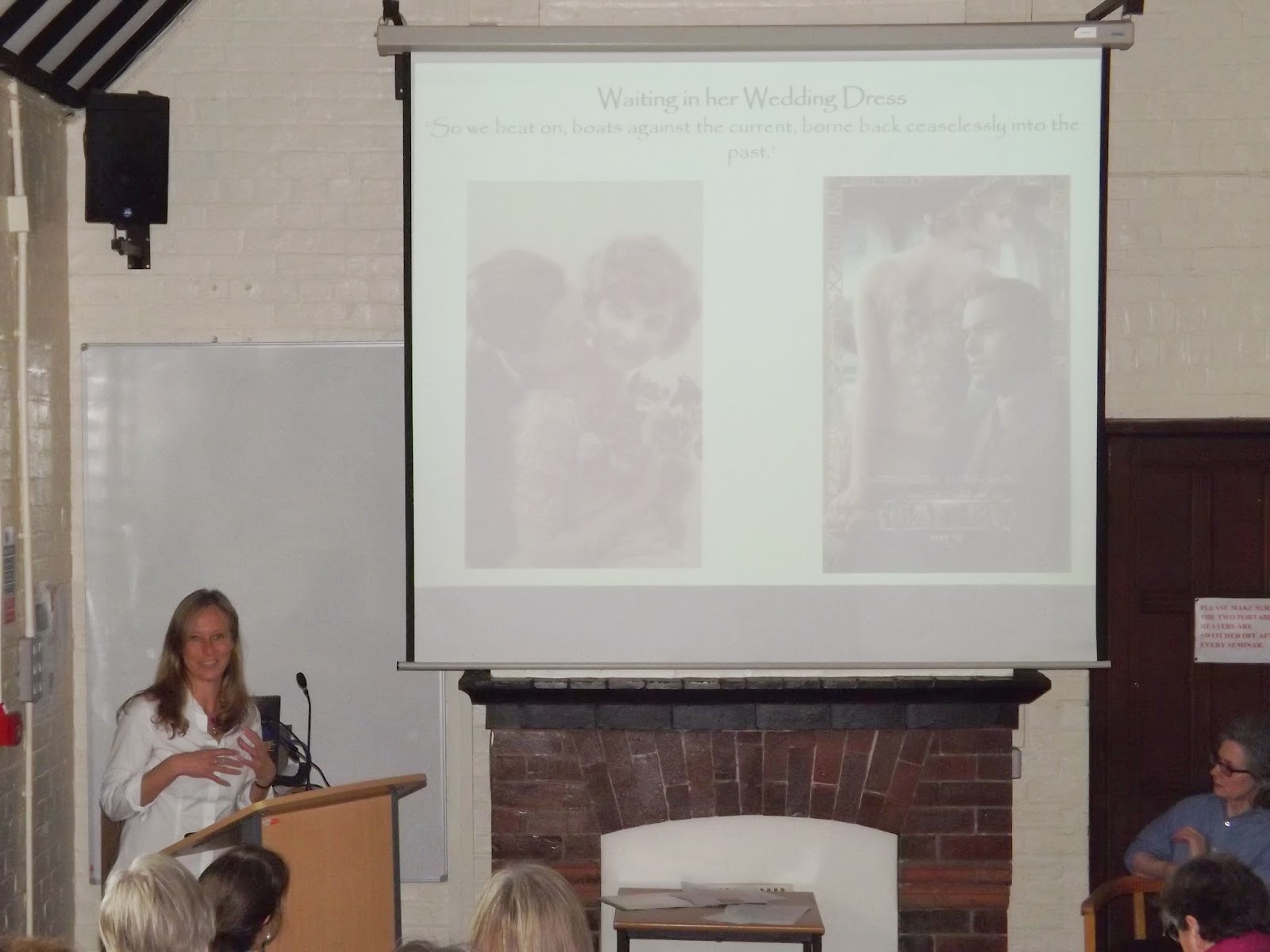
The third and final talk of the afternoon was delivered by event’s organisers, Professor Deborah Wynne and Dr Sarah Heaton of the University of Chester. Entitled, ‘Costume on Film: The Piano (1993) and The Great Gatsby (2013)’, the talk looked at the ways in which costume is used as both representative of historical period and as symbolic in each of the respective works.
 

       Professor Wynne’s piece focused on 1993 film, The Piano and how director Jane Campion uses the crinoline, particularly its cage-like form, as a direct metaphor for the confinement and personal imprisonment of the film’s heroine, Ada McGrath. Campion uses costume to portray Ada’s suffering while trapped in an abusive marriage yet also, conversely, her freedom once she is free of her husband. Throughout the film, differing forms of costume are used to represent imprisonment, freedom and, importantly, the differences between Ada’s public and private experiences – her crinoline is used to encompass her lover during their first sexual encounter.   
 

    Textiles, and the spaces they encompass, play an important role in Campion’s representation of Ada’s exploration of her own freedoms as the film progresses, notably when Ada must practise her own voice once her symbolic one, the piano, is lost. Interestingly, Campion shows Ada covering her face with a cloth before she reveals her new identity.


       Dr Sarah Heaton’s section of the talk looked at the ways in which costumes, particularly wedding dresses, are used in the 2013 film adaptation of F. Scott Fitzgerald’s, The Great Gatsby. Central to the symbolism of the film are Daisy’s dresses, she frequently wears ‘wedding dresses’, or at least wedding-style dresses which appear to centre her in a Miss Havisham-style crisis of identity. Like Miss Havisham, Daisy remains trapped and suspended in time, located in events that didn’t take place, but still may occur leaving her with a skewed sense of reality and sexuality.
 

       Dr Heaton looked at how the 2013 film edition of the novel took a nuanced approach to the past, particularly in its costume design. Daisy’s costume, for example, is given a much more traditional approach to its design with her barely there, naturally coloured tights. Myrtle, on the other hand is portrayed much more sexually with fairly unconventional roll-down tights.
 

     Interestingly, as the film progresses, the wedding dresses worn by Daisy alter, with less elaborate fabrics and lace adornments.  By the end of the film, Daisy leaves wearing no wedding dress at all and a full fur. 

Members of the audience were invited to comment on their experience of the event:

FEEDBACK COMMENTS

‘Totally brilliant from start to finish. […] Excellent speakers and variety. Congratulations to the organisers.’

‘All speakers – very enjoyable. I loved seeing “tried on” costumes and weaving of the Egyptian children’s clothes. Good variety of visuals and lecture styles. Will look at film and TV dramas in a different light!’

‘This was a very enjoyable day with high calibre speakers inspiring further exploration of all aspects covered. Thank you very much.’

‘I have really enjoyed today with the variety of speakers. It’s been a great experience, very well timetabled. Great to be able to chat to speakers and other members of the audience. Great use of artefacts, media and film, as well as reproductions of costume.’

‘Presentation for a Costume Day was excellent for Gillian Stapleton as ‘Jane Eyre’. Thank you for the whole day and its organisation.’

‘Really interesting day […] I enjoyed Gillian Stapleton, the enthusiasm of Veronica Isaac and the historical fascination of Jacqui Hyman. I’ve never seen “The Piano” but I will now!’

‘Absolutely great! Information and accessible and of very great interest. Speakers were all engaging in their very different ways. Loved it.’

‘Enjoyed the day very much, particularly the talks on the meaning and imagery of costume in literature and film. Lots to talk about. Nice lunch as well!’

‘This has been a superb event. The speakers were wonderful, extremely interesting, and their knowledge is fantastic. It was extremely well organised.’

‘Very enjoyable. Loved the variety of the topics. Could we have 3 lectures on the morning and two in the afternoon and start at 10am?’

‘Absolutely superb! A huge breadth of experiences and great interest. The topics were so interesting and engaging – thoroughly enjoyable. A great idea to have a costume historian wear costume as she describes it piece by piece. The presentations were full of interesting detail, quality information and clear good quality speakers. A fascinating journey on textiles. Please put more events on.’

‘I particularly enjoyed the diversity of the topics covered. Hope that the success of today will encourage the department to continue to do more of these days.’

‘Interesting and varied. Very enjoyable.’

‘Excellent venue and hospitality. Very well organised – excellent and varied speakers. Tremendous depth of knowledge and range of talks that link together well.’

‘Absolutely fascinating day with an excellent variety of speakers. If possible for the next one, it might be an idea to start a little earlier, as it’s a shame to overrun.’

‘Superb day. Even better than last year. All the sessions were fascinating and professionally delivered.’

‘It was very interesting hearing about the Medieval Egyptian clothing. […] Gillian Stapleton, very engaging speaker and loved the fact that she had examples. Overall an excellent day, very enjoyable and very thought provoking.’

‘Jacqui Hyman and Gillian Stapleton were interesting speakers. Please keep to time – shorter lunch!’

‘I found the Ellen Terry talk very worthwhile.’

‘A good variety of topics but with a thread running through it. Lovely lunch and interesting people to talk to, too!’

‘Excellent day with great variety and talent from the speakers.’

‘Wonderful day. Interesting, committed speakers. Varied deliveries. Very friendly atmosphere. Made to feel welcome from stepping through the door.’

‘Great day, very interesting, enjoyed all the speakers – loved the variety. Can’t wait for the next one.’

‘I have thoroughly enjoyed today’s programme and found the variety of speakers most stimulating.’